Laboratory Work
Variable controlled experimentation in Romania
Data Collection
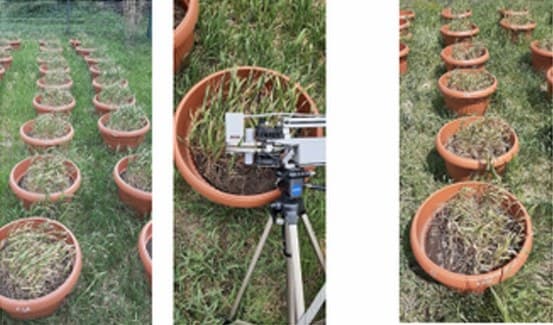
The pot experiment of the "Aurel Vlaicu" University of Arad: wheat grown under controlled stress, measured against a control, as described in the university's activity report.
Study design
The study tests whether stress changes measurable characteristics of wheat as it grows: whether the differences between stressed plants and the control are statistically significant or only random.
| Independent variables |
|
|---|---|
| Measured (dependent) variables |
|
| Held constant |
|
| Stressors |
|
Each stressed series is compared with the control sample using a single-factor ANOVA (Fisher's F test) in MS Excel, over two replications (2025 and 2026). H0: the series do not differ and any difference is random, so the stressor had no effect. H1: the series differ, so the stressor changed the characteristic.
The first season, step by step
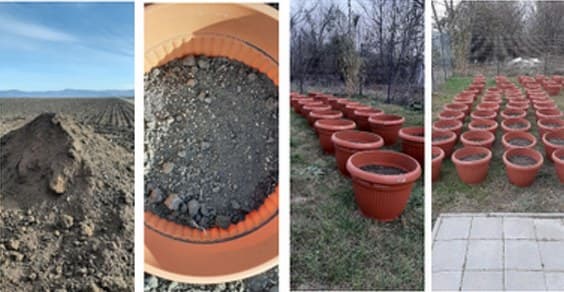
Pots filled with farm soil, winter wheat sown
The pots were filled with soil from a farm, so that soil conditions match those of plants grown on a farm, and kept in the open air for the same reason. The winter wheat was sown on 19 November 2024, about a month later than a normal October sowing: low temperature is the first stressor.
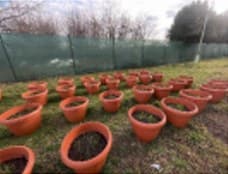
Slowed development
Sown late into colder weather, the plants grew more slowly than in a normal season.
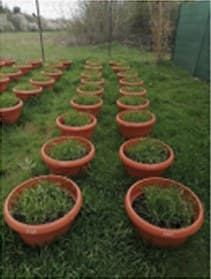
Growth, then a frost
The wheat was developing well until temperatures swung from 20 °C to −5 °C within a week. Combined with too little water in the soil, two stressors overlapped: temperature and humidity.
–
Soil humidity measured, fertilization applied
No treatment was applied until 24 April 2025. That day the low soil humidity and the photosynthesis parameters were measured, and the different fertilization treatments were applied, followed by watering so the nutrients would be absorbed. The aim is to see whether, and how far, the plants recover after deep water deprivation.
–
Spring wheat sown
The spring wheat variety was sown on 24 April 2025 with the different fertilization treatments, and watered so the fertilizer would be absorbed. The unsown soil had kept enough water for the seeds to germinate in only four days.